From Payroll to Platform: Understanding the Different Models of MSOs in Legal Services

As Managed Service Organizations (MSOs) gain traction in the legal industry, it is tempting to view them as interchangeable. In reality, the structure, scope, and sophistication of MSOs vary widely. Some operate as little more than outsourced back offices, while others represent transformative platforms that enable firms to scale, attract investment, and deliver higher value to clients. Understanding these differences is essential for a law firm leader considering whether (or how) to adopt the MSO model.


The Spectrum of MSOs in Legal Services
 
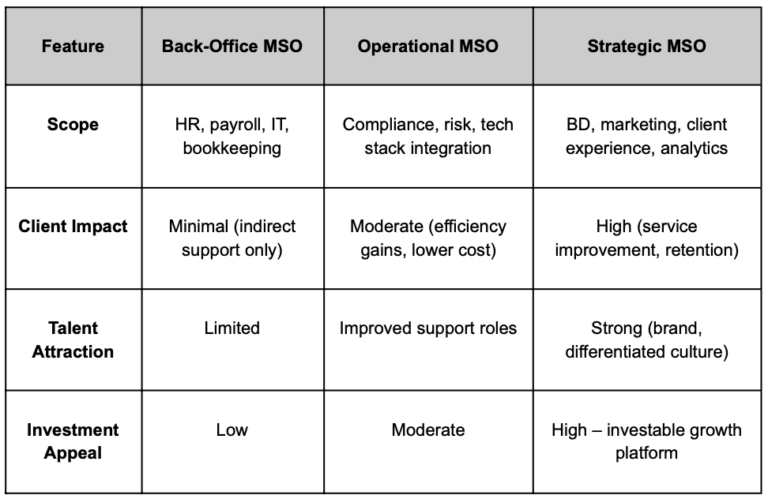
Back-Office MSOs (Administrative Support Only)

At the entry level, some MSOs provide only payroll, benefits administration, accounting, and IT support. While these functions are critical, they rarely differentiate a law firm or enhance client value.

Example: Some small and mid-sized firms in states like New Jersey and Florida have adopted MSO-style entities focused narrowly on HR and finance to comply with state ownership restrictions (ABA Journal).


Operational MSOs (Efficiency-Driven Models)

Operational MSOs centralize broader functions such as compliance, risk management, technology platforms, and vendor procurement. These models improve efficiency and reduce overhead but may still lack a client-facing dimension.

Example: UnitedLex, operating under a managed legal services model, offers enterprise-level support in e-discovery, contracts, and compliance. While not always described as an MSO, its structure mirrors many MSO principles.


Strategic MSOs (Growth Engines)

At the highest tier, strategic MSOs move beyond operational support to actively drive growth. They deliver marketing, business development, client-intake systems, data analytics, and even talent pipelines – operating as full-scale business partners.

Example: Elevate Services integrates consulting, technology, and operational support with legal services, bridging roles typically handled by separate entities.

Example: Axiom, originally known for contract staffing, has shifted into a hybrid legal/technology services model that competes for corporate legal department spend.

Example: Big Four firms (PwC, EY, Deloitte, KPMG) have built MSO-style infrastructure in jurisdictions where nonlawyer ownership is permitted (e.g., UK, Australia).


Comparative Benchmarks
Case Study: How One Firm Leveraged an MSO for Growth

Consider a 75-lawyer litigation boutique in the Midwest. Like many mid-sized firms, it struggled with inconsistent client intake, rising overhead, and partners bogged down by admin tasks.

By partnering with an MSO that delivered:

  • Centralized finance and HR
  • A tech stack for matter management and analytics
  • A dedicated business development team

This firm achieved:

  • 20% overhead reduction in the first 18 months
  • 30% increase in client retention, driven by improved onboarding and communication
  • 40% increase in partner billable hours as partners focused more on legal work

This example illustrates how evolving from a “back-office” MSO toward a strategic platform can reshape firm economics.


Why These Differences Matter

Client Expectations: Corporate clients increasingly demand value-based pricing, process transparency, and

technological sophistication. A simple back-office MSO cannot deliver on these; a strategic MSO can fulfill

those demands.

Regulatory Landscape: States like Arizona and Utah are pioneering reforms under Alternative Business

Structure (ABS) frameworks. Over 100 ABS entities have launched in Arizona and Utah (IAALS).

Competitive Pressures: The alternative legal services provider (ALSP) market now stands at approximately

$28.5 billion in 2023, growing at an 18% compound annual rate since 2021 (Thomson Reuters 2025 ALSP Report)

Market Entry by Big Players: KPMG recently became the first of the Big Four to obtain a license to practice

law in Arizona under its ABS program.


Building Toward Platform Success

Transforming your MSO from payroll support to a growth engine requires intention:

  • Align the MSO’s mission with the firm’s strategy rather than operating as a cost center
  • Ensure legal independence is protected via governance, role clarity, and compliance structures
  • Build client-facing capabilities that translate into referrals, retention, and market distinction
  • Measure with metrics (KPI dashboards, profitability by matter, cost trends)
  • Sequence growth (start with core operations, then layer in business development, analytics, etc.)


Choosing the Right MSO Model: Your Strategic Call

Not all MSOs are created equal. A back-office provider delivers foundational support, but a strategic MSO becomes the growth engine and differentiator. For law firms seeking modernization, competitive edge, and investment readiness, aligning with or building a strategic MSO is no longer optional – it’s the future of practice architecture.

Share the Post:

Related Posts

Leave a comment

Your email address will not be published. Required fields are marked *